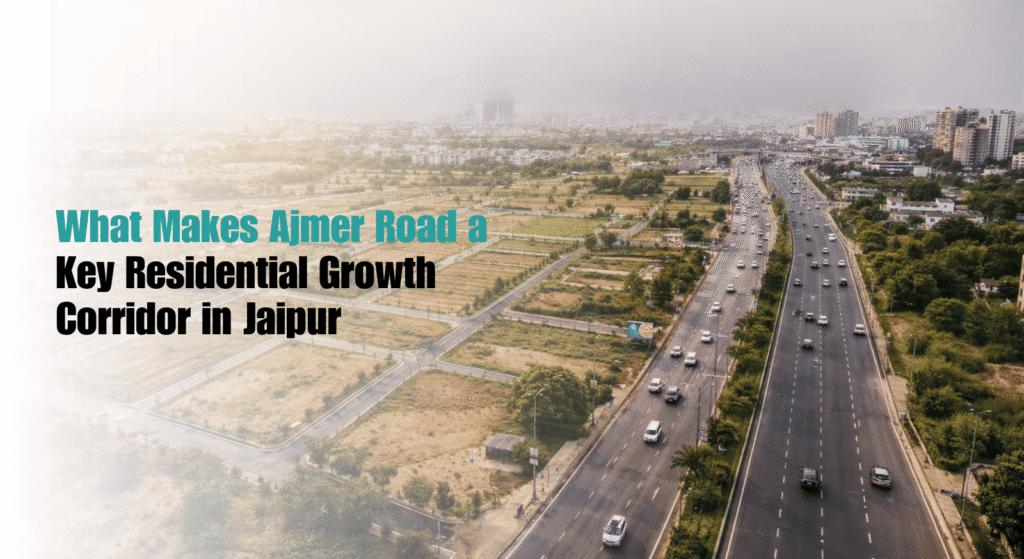
Five years ago, you would not have stopped on Ajmer Road unless your car needed fuel. That’s changed. The stretch west of Chitrakoot now has gated communities and land values to match. What was once open highway-side land has, over the last few years, quietly filled up with universities, industrial parks, and wide approach roads.
That stretch is Ajmer Road. And if you are seriously thinking of investing in a plot in Jaipur, then it is most important to know what is going on here before you make any decision.
How did it go from a Transit Route to a Living Destination?
For years, Ajmer Road was exactly what the name suggested. A road you took when going somewhere else. Residential activity was light, and most buyers didn’t think about this belt twice.
Ajmer Road and the broader corridor saw a 26.3% year-over-year price growth, making it one of the fastest appreciating zones in all of Jaipur.
This is not speculative momentum. It is backed by employment hubs, infrastructure timelines, and a growing population choosing this side of the city to put down roots.
Main Projects Set to Move Ajmer Road Prices in 5 Years
When most people think of the word infrastructure, they think in terms of a road being widened. However, in the case of the Ajmer Road residential corridor, it is something much larger in scope, and it is perhaps the largest reason why serious buyers are paying attention.
Connectivity is one of the aspects of this equation. NH 48, previously NH 8, provides direct connectivity to Delhi via the expressway. The stretch between Jaipur and Kishangarh has already been expanded to six lanes for access to the western part of this stretch.
The proposed new Ring Road is another part of this equation. This type of access is what determines if a residential development in Jaipur truly matures into a mainstream market or not.
As per the news reports, the Northern Ring Road will start from Bagru on Ajmer Road and will extend up to Bassi on Agra Road. This road will be approximately 100 kilometres long and will be a 6-lane highway. The maximum speed limit for vehicles on the new ring road will be 120 km per hour. So, Bagru, Ajmer Road will become a junction point of the 2 most important corridors of Jaipur – the existing Jaipur Ring Road(south side) and the new Jaipur Ring Road (north side).
These are the Ajmer Road infrastructure projects that do not always make front-page news but compound over time into measurable property value.
Who is actually buying, and why it is not only investors?
The Ajmer Road region has been developed on the Delhi-Mumbai Industrial Corridor. IT companies, manufacturing units, and business parks are all coming to one place.
The Bagru Industrial Area nearby adds another layer of employment density. Professionals working in these zones need housing within a reasonable commuting distance. That is a structural demand driver, not a cyclical one.
Jaipur recorded the highest price growth among Tier-2 cities in India. Ajmer Road is one of the primary corridors pushing those city-wide numbers. When you look at who is buying, the picture is fairly clear. Around 23% of properties on this stretch fall in the Rs. 40 to 60 lakh range, and another 21% in the Rs. 20 to 40 lakh range. That is the accessible mid-income bracket, which means genuine end-user demand rather than just investor speculation.
Bagru and Mahlan: Is it where the real opportunity sits right now?
Among all the Jaipur growth corridors, the Bagru-Mahlan belt on Ajmer Road is where the most interesting buying window currently exists.
Plots near Bagru Ajmer Road have shown consistent traction due to the combination of the availability of land at reasonable prices and the consistent demand created by the employment and educational opportunities in the area. Mahlan plots are currently priced around Rs. 12,000/- to Rs. 30,000/- per gaj, which gives buyers a clear entry-point advantage compared to zones closer to the city.
Plots near Mahlan have entered a completely different conversation because of Manglam World City. This is Rajasthan’s largest integrated township, spread across 1600 plus bigha on Main Ajmer Road. The project is JDA-approved and includes residential, commercial, and industrial zones within the same township. It offers a sports city of 65 acres, an IT park, hospitals, schools, colleges, and a central park of 11,000 sq. yds. The plot sizes are available from 500 to 2,000 sq. yds.
A project at this scale does not just serve its buyers. It lifts the entire micro-market around it. Schools, hospitals, and retail that come with a township of this size benefit every plot owner in the surrounding area, which is exactly why proximity to Mahlan is now a pricing factor in itself.
Educational institutions in this belt, including Manipal University, JK Lakshmipat University, and Arya College, bring consistent student and faculty demand for rentals. That population creates a rental income base for plot investors who choose to construct.
The Social Infrastructure That Makes It Livable
A real estate decision is also a lifestyle decision. The Ajmer Road residential corridor holds up on that front, too.
There are prominent colleges and universities on Ajmer Road, like Manipal University, Jyoti Vidyapeeth Women’s College, Haridev Joshi Patrakarita University, and Central University of Rajasthan. Geetanjali Hospital, Jaipur, a premier multi-super specialty tertiary care hospital offering comprehensive medical services under one roof, has come up on the Ajmer Road.
Ajmer Road also has the top schools of Jaipur, such as JPIS and DPS. Retail options like D-Mart are also established in the corridor. And for weekend getaways, there are Ajmer and Pushkar at 130 km down the same highway.
It is a highway that’s moved beyond mere habitability to become a place of choice for families to live, which is the ultimate measure of a place having arrived.
Conclusion
Ajmer Road is not a corridor you need to take a leap of faith on anymore. The data is there, the infrastructure timelines are documented, and the township-level development at Mahlan is already underway.
What makes this moment worth acting on is simply that the price gap between what it costs today and what it will cost once habituation extends, Ring Road is completed, and RERA registrations on major projects get finalized is still meaningful.
If you are looking at plots in the Jaipur market and want a location where your money is working from day one and has a verified runway ahead, the Ajmer Road residential corridor is genuinely hard to overlook. The buyers who moved to Mansarovar fifteen years ago and to Vaishali Nagar a decade ago are the reference point. This belt is where that story is currently being written.
FAQs
Yes, and it comes down to timing versus livability. Mansarovar plots are costlier with developed infrastructure and metro access, while Bagru Mahlan plots offer higher 7–10 year appreciation potential.
The proposed ring road in Jaipur is a major project aimed at reducing traffic congestion. Phases I and II has been developed along a 47 km stretch in the south connecting Ajmer, Tonk, and Agra Roads, while Phase III will add a 97.75 km stretch in the north linking Agra, Delhi, Sikar, and Ajmer Roads.
Ajmer Road is one of the most dynamic growth corridors in Jaipur. This is especially true with the development of the SEZ zone. What was earlier a quiet stretch is now fast transforming into a thriving hub for both work and living. This is attracting tremendous attention from working professionals, as well as NRIs, for investment.