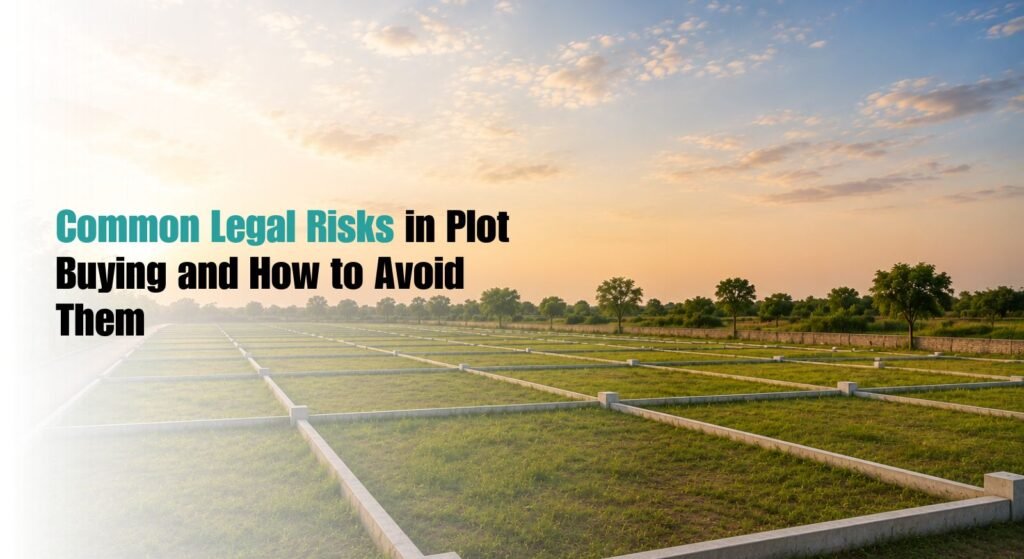
Buying a plot feels like one of those decisions you make once and benefit from for a lifetime. But the Indian real estate market, for all its opportunities, has a side that does not get talked about enough. People lose lakhs, sometimes crores, simply because they skipped a document check or trusted the wrong seller. If you are actively looking at plots right now, understanding the legal risks in buying a plot could be the single most important thing you do before signing anything.
While some risk factors are evident upfront, others do not appear until the transaction has been completed. Everything from fake documentation of ownership to pending lawsuits can make even the smallest mistake cost you your fortune in litigation. Let’s learn common Legal risks involved and how to prevent them.
1. Fake Property Registry
One of the most damaging traps buyers fall into is purchasing a plot based on forged documents. Fraudsters use manipulated title deeds, fabricated sale deeds, and fake property registry documents to make an illegal property look clean on paper.
What makes this dangerous is that even a document registered at the sub-registrar’s office does not guarantee valid ownership. Registration only records a transaction. It does not confirm the legal standing of the seller. So if the seller had no rightful ownership to begin with, the registry holds no value.
Always cross-verify ownership documents directly at the sub-registrar’s office and run an encumbrance certificate check covering at least 15 to 30 years. A clear title property check done by a practising property lawyer is not optional here. It is essential.
2. Land Dispute Issues That Surface After Purchase
You found a plot, the price was fair, the location was ideal, and six months after registration, someone shows up claiming ownership. Land dispute issues are extremely common in India, especially on plots that have passed through multiple hands or were part of ancestral or joint family property.
Sellers do not always disclose pending litigation. Sometimes they genuinely are unaware of it; often they are not. Either way, the buyer ends up fighting a legal battle they never anticipated.
Before finalising any deal, check for existing litigation at the local civil court. Also, verify mutation records, known locally as jamabandi or khasra, at the tehsil office. These records confirm if ownership has been correctly updated in government revenue files. Any mismatch here is a serious red flag worth investigating before putting money down.
3. Illegal Land Sale: Agricultural Land Passed Off as Residential
This catches a lot of buyers off guard. In Rajasthan, agricultural land cannot be legally used for residential construction unless it complies with the applicable land-use regulations and approvals. Many sellers and agents attempt to sell agricultural plots at near-residential prices without ever disclosing these restrictions.
Without the necessary approvals and clearances, the plot may face registration challenges, banks may refuse financing, and authorities can deny building permission entirely.
This is precisely why JDA approved plots carry such genuine weight. A JDA-approved plot means the land has cleared all formal checks for layout, land use, road access, and construction permissions, none of which are available with an unapproved or unconverted agricultural parcel.
4. Unapproved Layout Risks
A residential colony can look completely functional, with roads, boundary walls, and active construction, but if it lacks layout approval from the relevant authority, like JDA, Nagar Nigam, or Gram Panchayat, every plot within it carries real legal exposure.
Unapproved layout risks are serious. Such plots are routinely denied building permits, banks refuse to finance them, and if authorities move against the illegal development, demolition becomes a possibility. Most buyers find this out only after their life savings are already committed.
Before purchasing, always ask for the approved layout map with the specific plot number marked on it. Verify it on the JDA portal. If the seller is reluctant to share this, it is a dealbreaker, not a minor concern.
5. The Double Sale Trap
A single plot sold to multiple buyers is more organised than it sounds. Fraudsters take advantage of the period between signing the agreement and registration to make money from several buyers at once.
Legally speaking, the buyer who completes registration first has the upper hand. However, by then it’s already too late since the seller disappears. The rest of the buyers have no choice but to fight legally. It sounds like something out of a movie, but in reality, there was an incident in the state of Rajasthan, where a Jaipur-based operator faced over 300 FIRs for allegedly forging property documents and reselling the same plots to multiple buyers, causing estimated losses of at least ₹150 crore and triggering an Enforcement Directorate investigation.
This is exactly why understanding how to avoid property fraud becomes critical before entering any land deal.
Complete registration promptly after agreement. Avoid large cash payments since the Income Tax Act prohibits cash transactions exceeding Rs 2 lakh in property deals. Insist on a properly executed sale agreement with all documentation in place before any money is transferred.
6. Why JDA, Government Approved and RERA Approvals Actually Matter
There is a tendency to treat approvals as mere technicalities. They are not. They are your most reliable protection against property fraud when buying plots.
The RERA-approved plots in Jaipur come under the Real Estate Regulation and Development Act, 2016, which states that developers should make all project information known to the public. Funds of the developer have to be deposited in a special account that can only be utilized for the development of the project itself.
The JDA-approved plots in Jaipur ensure that the area is free for residential construction purposes within the planning regulations. Besides JDA approved colonies there are government approved colonies that are also legally approved and are safe to invest in. In government approved colonies you can check the map which should be approved by the Sub Divisional Officer (SDO) or district collector. In case of government approved colonies the layout plan is approved by the Senior Town Planner.
The proper road width and drainage facilities also need to be followed according to the regulations. Home loan sanctioning by banks for the approved plots can speak for themselves regarding the significance of the certification process.
Choosing RERA approved plots is not about paying for paperwork. It is about paying for legal accountability backed by a government mechanism. That distinction matters enormously when your investment is on the line.
Closing Insight: Safety in Property Deals
Property fraud does not always look like fraud. It looks like a good deal. It looks like a seller who has all documents ready before you even ask. It looks like a plot priced slightly lower than everything else around it.
The safest investment is a slow, careful one. Verify the title. Confirm the approvals. Work with a lawyer. If something feels off, walk away. There will always be another plot, but money lost to a fraudulent land deal is rarely recovered.
FAQs
Yes. Registration records the transaction but does not confirm that the seller had rightful ownership.
Permission for construction as well as financing will most probably not be granted, depending on the legality of the colony.
In Rajasthan, “Society Pattas” (issued by housing cooperative societies after certain cutoff dates) carry a notorious history of legal disputes. Many backdated cooperative pattas are legally invalid post-1999. The society patta colonies which are not approved by any government authority should be avoided so that your hard earned money is not wasted.
Visit the JDA portal enter the layout reference or plot number, and cross-check the approved layout map against the seller documents.
Yes, the government approved colonies are also legally approved and are safe to invest. In government approved colonies you can check the map which should be approved by the Sub Divisional Officer (SDO) or district collector. In case of government approved colonies the layout plan is approved by the Senior Town Planner. You can check with the developer sales team if the project is approved for home loan by leading banks such as SBI or ICICI or a major Non Banking Finance Company (NBFC).