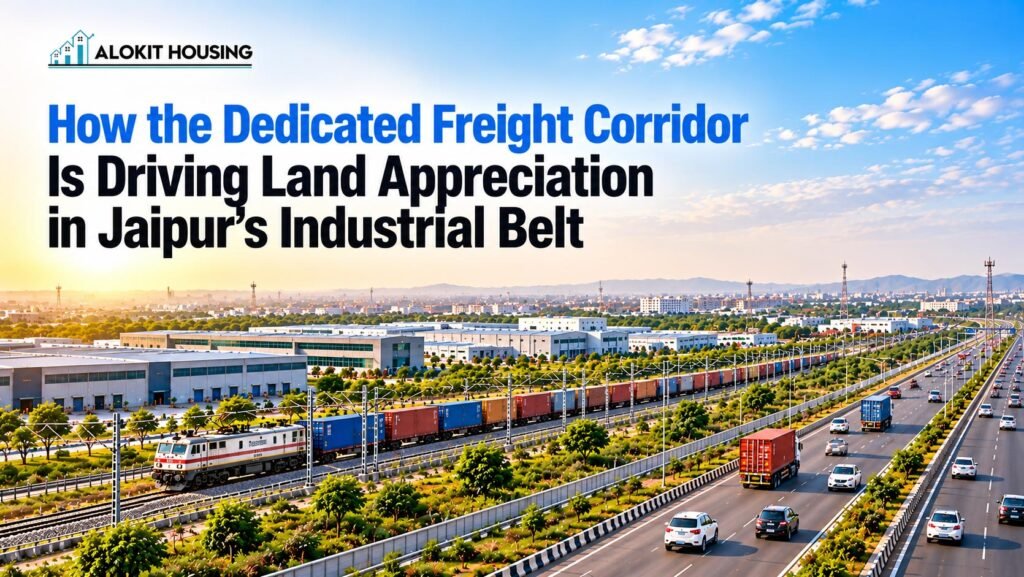
Jaipur is no longer only a heritage city and tourist attraction. It has become an increasingly important industrial real estate market of North India. The key factor that has led to this development is the Western Dedicated Freight Corridor (DFC), which is an operational high-speed railway for the transport of freight running through Jaipur, Ajmer, Sikar, Nagaur, and Alwar districts.
The way land appreciation in Jaipur works when this kind of logistics infrastructure comes into a particular region is predictable: good infrastructure leads to industrialization, industrialization attracts labor force, and land appreciation is the result. This article will explain the way DFC is changing the game for Jaipur’s industrial real estate.
What Is the Dedicated Freight Corridor and Why It Matters for Jaipur
Western Dedicated Freight Corridor (DFC) is a 1506-km-long freight train route running from Dadri in Uttar Pradesh to Jawaharlal Nehru Port near Mumbai, crossing five states, viz. Uttar Pradesh, Haryana, Rajasthan, Gujarat, and Maharashtra.
Approximately 40% of this route lies in Rajasthan, which includes a 227-km Rewari-Madar route in the districts of Jaipur, Ajmer, Sikar, Nagaur, and Alwar, as per Press Information Bureau reports. This part of the corridor includes new junctions like Phulera Junction near Jaipur.
Logistics infrastructure moves land prices because it fundamentally changes what a parcel of land is for. A field that was once suited only to agriculture becomes viable for a warehouse, a logistics park, or a manufacturing unit once freight movement time and cost drop. This is the same mechanism now unfolding across Jaipur’s industrial corridor, which Jaipur planners have been building toward for the past several years.
The Rise of Jaipur’s Industrial Belt
Jaipur’s industrial growth is expanding beyond traditional RIICO zones. RIICO is developing the Kunjbiharipura industrial area near Mahlan, Bagru, Ajmer Road, across 1,213 acres with 500+ industrial plots, close to Manglam World City.
Business Standard also reported plans for 14 new industrial areas, including Kankani, Bichoon, Salarpur, and Keru. Officials have identified Manda Extension near the Western DFC and the Dausa-Bandikui region near the Delhi-Mumbai Expressway as major future industrial hubs.
Site inspections by the Managing Director of RIICO at the end of 2024 inspected land sites at Manda, Phulera, and Bichoon for development of logistics parks, and the state is looking to acquire 200-250 hectares of land for such projects. This is the Jaipur industrial belt in action: manufacturing, warehousing, and logistics parks located near the same few DFCs.
How Industrial Growth Is Fueling Land Appreciation in Jaipur
The correlation is direct: better freight connectivity lowers logistics costs, which attracts industry, which brings jobs, ancillary businesses, and housing demand, and land appreciation in Jaipur follows. According to Tribune, Manufacturing already contributes about 24% of Rajasthan’s gross state domestic product, and the government’s own positioning around the DFC and DMIC treats industrial land near these corridors as a strategic asset, not just an operational one.
This is showing up in real estate appreciation data in Jaipur as well. Land values on Ajmer Road, which is a corridor accessible from RIICO’s industrial areas, have increased considerably. As per 99acres.com, the price for the land on Ajmer Road has increased by about 116% in five years, whereas the one-year increase has been moderate, indicating long-term optimism instead of short-term speculative behavior.
Property Investment Near Industrial Areas: What Buyers Should Know
It is important to note that buying land close to an industrial node is different from buying land at an industrial node. Land that borders directly on an industrial node is usually classified as industrial land, which means that it is suitable for use in constructing factories and warehouses.
The real property investment opportunity near industrial areas for the average buyer exists in land that borders outside of these industrial zones, where proximity exists but zoning regulations do not.
Infrastructure timelines matter just as much as location. RIICO’s newer industrial areas (Kunjbiharipura, Bichoon, Manda Extension) are still in various stages of land acquisition, planning, or early development, which means the appreciation curve is front-loaded for buyers who move before roads, power, and water infrastructure are fully in place. This is the core logic behind industrial land investment Jaipur strategies: value tends to compound fastest in the gap between “announced” and “operational,” not after.
The buyers must also pay attention to proximity considerations. Verifying current zoning status and RIICO’s published area boundaries before purchase is a non-negotiable step, given how quickly notified boundaries can expand.
Residential Plots in Jaipur: Riding the Industrial Wave
Every industrial cluster brings a workforce, and every workforce needs somewhere to live. As factories, warehouses, and logistics parks near the DFC corridor come online, demand for housing within a commutable distance follows, a pattern already visible in how quickly land rates in emerging Jaipur localities have moved compared to the city’s older, saturated pockets.
Residential plots in Jaipur located within a reasonable radius of these industrial nodes are increasingly attractive to two buyer types: end-users planning ahead of infrastructure completion, and investors betting on the same appreciation curve currently visible along Ajmer Road and Shivdaspura.
This worker-driven demand cycle is precisely why land appreciation in Jaipur tends to spread outward from industrial nodes in rings: first the immediate periphery, then well-connected residential belts a few kilometers out. Buyers entering earlier in this cycle are positioned closer to the ground floor of that curve than those who wait for industrial areas to be fully operational.
Where the Corridor Stands Today for Property Investment in Jaipur
Timing in industrial-linked real estate tracks infrastructure milestones, not calendar years. The Rewari-Madar DFC section is already operational, freight trains are running, and RIICO’s newer industrial areas around Manda, Bichoon, and Kunjbiharipura are in active planning and land-allocation phases rather than distant proposals.
That combination, live freight infrastructure plus industrial land still being notified and developed, is typically when property investment in Jaipur offers the most room between entry price and eventual value. For long-term investors, the best time is usually when infrastructure is confirmed, but development is still in progress, as seen along Ajmer Road.
Conclusion: The Long-Term Outlook for Jaipur’s Industrial Real Estate
The Dedicated Freight Corridor has given Jaipur’s industrial belt a structural, long-term growth driver rather than a short-term boost. As RIICO’s new industrial areas move from planning to operation and freight connectivity continues to mature, the appreciation trajectory already visible in corridors like Ajmer Road is likely to extend to the newer nodes now taking shape around Bichoon, Manda, and Kunjbiharipura. For buyers looking to enter this market with the right guidance, Alokit’s JDA-approved plotted townships across Jaipur’s growth corridors are a good place to start exploring what’s available today.
Frequently Asked Question:
1. How is the Dedicated Freight Corridor affecting land prices in Jaipur?
The DFC will increase the demand for land close to the industrial belt of Jaipur, making those plots highly appreciated with the expansion of industries in the nearby region. The regions that have connections to RIICO, Mahindra World City, and highways have greater potential in this regard.
2. Which areas near Jaipur’s industrial belt offer the best investment potential?
The corridor from Mahindra World City, Bagru, Chomu, and the extension of Tonk Road provides excellent investment opportunities because of its excellent infrastructure and development prospects in terms of housing and industry.
3. What are the factors behind the appreciation of real estate in Jaipur’s industrial belt?
These factors are industrial growth, road connectivity, employment generation, RIICO projects, and the increasing need for housing and logistics.