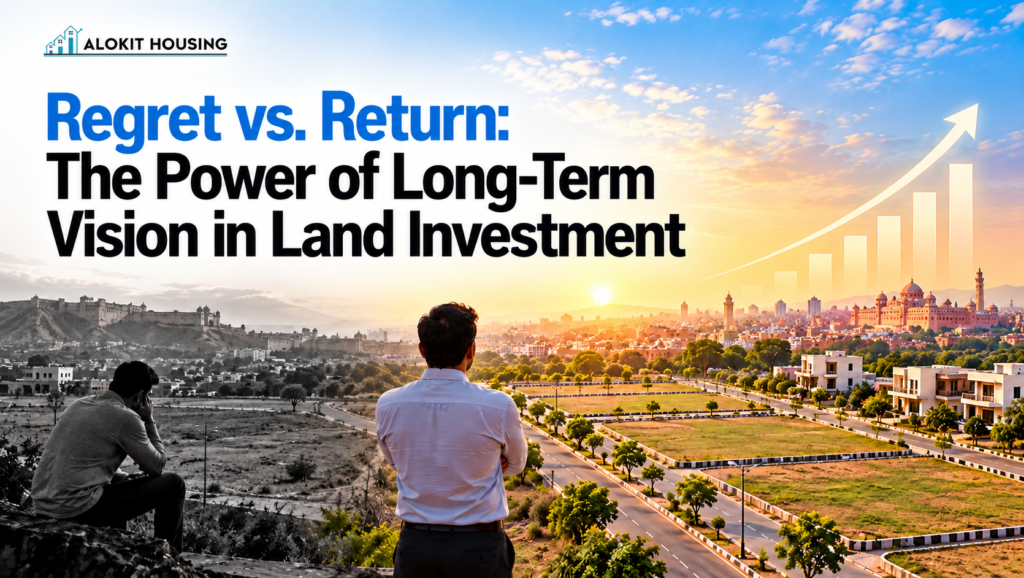
The history of real estate is full of stories that begin with a common theme: “I could have bought that plot for peanuts ten years ago.”
When investors look back at changed urban landscapes, hindsight gives them 20/20 vision. They recall the huge tracts of empty land beside the highways that were once considered “too far out” or “in the middle of nowhere.” But those who had eyes to see beyond the horizon, foresight rather than hindsight, built wealth from modest capital.
The continuous tug of war between precaution and strategy creates real estate wealth. This is nowhere more apparent than in the capital of Rajasthan. For all those contemplating a land investment in Jaipur, the capacity to look beyond fear into the future is the most important.
This blog describes the factors affecting land investments, including time frame, corridors, and key points to consider.
The Psychology of Real Estate: Why Short-Term Mindsets Lead to Regret
By nature, the human brain is set up to seek instant gratification and security. When people value their assets, investors would prefer a source of quick revenue from rentals or even liquidity and fully developed surroundings.
The problem is that once the area is developed, there could have been a rise in price that has been taken into consideration by the developer, hence reducing future price increases.
With the construction of paved roads, commercial hubs, and streetlights in place, the toughest bit of the value appreciation journey is normally over.
- Land Ownership and Long-Term Value
Buildings depreciate and require maintenance all the time. The land never wears out; thus, it is determined by the location and demand. Prices may be stagnant or go down, which means that this is not a guarantee of profit.
- Low Operating Expenses
The ownership of land requires lower expenses compared to apartments and buildings. However, you need to account for taxes and occasional visits to the plot, as well as fencing the borders of the land.
- Expansion of Infrastructure Corridor
Generally, cities develop along the lines of infrastructural corridors. The land within these corridors tends to increase in value gradually.
The mistake that investors make a few years down the road does not lie in their risk-taking. It lies in their short-sightedness.
Why Jaipur Is the Ideal Place to Invest Strategically in Land
Jaipur has come a long way from its reputation as being a heritage tourism centre. Presently, it is one of the emerging Tier 2 economy cities of North India due to urbanisation, the IT industry, educational institutes and manufacturing industries.
For patient investors, long-term land investment in Jaipur presents an opportunity to get in at rather reasonable rates.
Key Economic Drivers Accelerating Growth
Jaipur’s growth story is increasingly based on the fundamentals which investors look for, namely a diversified economy supported by the sectors of tourism, handicrafts, and the growing IT industry, as well as infrastructure investment.
Better connectivity from Delhi NCR, the construction of expressways, and development of new job clusters are driving demand and increasing the value of land in the outskirts of the city. For early buyers, these zones present buying opportunities and chances of appreciation that do not persist after a certain point in time.
1. Connectivity Infrastructure
Jaipur Ring Road has initially been conceptualised as an approximate loop of 145 km. Out of which, only the southern part, which is about 47 km, has been constructed, while the northern part is still under construction, and its length has been revised from the initial design.
2. Growth of Industries & Technologies
Mahlan-Bagru belt along the Ajmer Road is attracting more industries as well as new townships. Bagru Industrial Area and Chhitroli Industrial Area lie along the highway while some more recent industrial areas like Bichoon and Kunjbiharipura of RIICO are coming up in the neighborhood. Mahlan has one more big project – the 2,400+ bigha Manglam World City, a JDA approved township consisting of a residential area, commercial area and IT park.
3. Institutional Growth
The educational and healthcare facilities in Jagatpura and Tonk Road keep attracting development towards the south and east directions.
As the cities grow more crowded and costly, people move towards these corridors, and this may lead to the growth in value of the land for early investors.
Return on Investment Analysis: Micro-Market Case Studies
To understand the implications of long-term planning, consider the growth pattern along the main development corridors of Jaipur:
| Growth Corridor | Key Development Catalysts | Historical Growth Profile | Connectivity and Infrastructure Advantage |
|---|---|---|---|
| Ajmer Road (Mahlan-Bagru Belt) | Bagru & Chhitroli industrial areas, Manglam World City, NH-48 | High valuation driven by business and industrial growth. | 2,400+ bigha Manglam World City township; on NH-48; planned Northern Ring Road starts near Bagru |
| Tonk Road & Sitapura | Proximity to Airport, Institutional Centres, Ring Road Junctions | Consistent urban integration and high residential demands. | Metro Phase-2 (41 km, 36 stations, ₹13,037.66 crore) approved by the Union Cabinet, linking Sitapura, the airport and Tonk Road. |
| Jagatpura / Mahal Road | Educational Clusters, Metro Expansion, Premium Housing | Rapid conversion to a high-density housing area. | Approximately 7 km away from the airport, accessible to the commercial zone of Tonk Road and the Ring Road. |
| Agra Road Corridor | Proposed Heritage Township, Ring Road Eastern Connectivity | New peripheral market that has a low entry barrier. | Bandikui Spur of length 66.9km is operational, providing direct access to Delhi–Mumbai Expressway. |
Investors who have purchased land on Ajmer Road, Ring Road or Jagatpura about ten years back probably invested at a time when there were few commercial setups. After a decade, with huge commercial and infrastructural development in areas including Ring Road, land prices have increased.
Strategic Blueprint: How to Execute an Investment in Land in Jaipur
Simply purchasing a piece of property and neglecting it will seldom yield exceptional gains. It is a process that successful investors have adhered to while making investments in Jaipur.
1. Prioritise JDA Approval and Title Verification
Legal safety is the foundation of any sustainable real estate investment. Prefer JDA-approved plots or schemes registered under Rajasthan RERA. None of these individually gives clear evidence of title, so it is important to check the seller’s title papers, encumbrance papers, and any charges against the property.
2. Focus on Future Infrastructure, Not Current Population
Choose land according to existing plans for infrastructure, not currently available facilities alone. New highway exits, ring road connections, and industrial areas determine where future urban influx will take place. Always verify in written term instead of taking the word of the seller.
3. Maintain a Long-Term Holding Horizon
Investing in land requires commitment. Buying and selling is associated with recurring transaction costs, but long-term holders have more chances to benefit from the whole range of value of undeveloped land. The typical duration of investment can be between 3 and 10 years, but this period is not guaranteed.
Authentic Sources and Regulatory Agencies
While researching the authenticity of properties, master plans, and other necessary information for land dealings in Rajasthan, please always verify from the following authentic sources:
- Jaipur Development Authority (JDA)
For master plan layout, land conversion details, and sector plans. - Real Estate Regulatory Authority (RERA Rajasthan)
For township project registry. - Revenue Department, Government of Rajasthan (Apna Khata)
For checking government records related to land ownership (Jamabandi). - National Highways Authority of India (NHAI)
For expressway, bypass, and Ring Road alignments.
Conclusion
Every developing city has a window of opportunity when the land is still available before it becomes too costly. Jaipur seems to be at such a stage at the moment.
The real tradeoff here is not between risk and security but rather between time and vision. With the help of high-potential corridors, proper legal due diligence, and patience, one will be able to make the best out of an opportunity lost.
Frequently Asked Question:
1. Is it safe to make an investment in the lands situated outside of Jaipur?
Certainly, provided all the legal checks are done properly. Ensure that the land is either JDA approved or RERA registered, and the ownership status can be cross-checked on the Apna Khata Revenue portal.
2. How long should one hold land to gain maximum appreciation in Jaipur?
Approximately 3-10 years, depending on how developed the area is and how rapidly infrastructure is accomplished. This is only an indicative timeline.
3. Why land over residential apartments in Jaipur?
Land increases in value with improvements in infrastructure, while the building depreciates due to structural ageing. Land has no maintenance costs and also lacks tenant management costs; however, there will be land taxation and minimal maintenance expenses such as fencing.
4. Which Jaipur corridors have the highest growth potential?
The growth potential is concentrated in the Ajmer Road SEZ corridor, the Tonk Road & Ring Road junction at the airport, the highly liquid Jagatpura & Mahal Road zone, and the Agra Road greenfield corridor.
5. What are the important documents that should be checked before purchasing?
Before purchasing land, an investor must have some important documents. Always check the original Title Deed, JDA allotment letter, RERA registration, latest Jamabandi document from Apna Khata, and Non-Encumbrance Certificate.