Few real estate strategies offer anticipation as well as land banking before the growth trend takes place. Whether it’s private equity firms or sovereign wealth funds, advanced players have been using land banking as their key vehicle in preserving and multiplying their wealth.
Most individual investors lean towards ready apartments or offices. Big players do something else. They buy big chunks of raw land and wait for urban infrastructure to reach that area, then sell at much higher prices when the demand for development reaches its peak.
Understanding this approach is useful for any individual investor who wants to build wealth through real estate.
Understanding of Land Banking
Land Banking is the purchase of unbuilt land which is on the projected path of future growth, without developing the land or leasing it out, until roads, employment, and housing drive up the price. Appreciation is the entire gain to be made, and you are carrying the risk and expenses until then.
It is common for institutional investors and big developers to acquire the land ahead of construction. That provides helpful context. Individuals can’t copy institutions directly, but can use the same principles. They can finance the permits and ride it out through an extended market.
The legalities of that particular parcel of land, and how long you can go without using the funds, are more important than any corridor story.
How individual buyers can apply it
While using land banking as an individual is not reliant on having institutional level funding, it does call for a very methodical approach. In effect, an individual using the same fundamentals that larger developers use will be able to decrease risks and build capital appreciation at the same time.
Invest early in a developing corridor
Seek a developing corridor in which there are several factors in play but have not yet been implemented.
Check the approvals
If an individual doesn’t have a plot that they can use, it is worthless regardless of how cheap it is.
Be patient
Think long term, using funds that an individual will not need for many years.
Why Do Institutional Investors Prefer Land Banking?
Institutional investment funds have a lot of capital under management, so capital preservation, appreciation, and inflation protection matter. That is why land banking continues to be the staple of institutional portfolios:
1. Asymmetrical Returns and Value Generation
The value of buildings depreciates while their maintenance cost remains fixed, but the value of land can appreciate with the development of cities because land is fixed in supply. Institutional investors acquire large tracts of land and then sell them in smaller parcels.
2. Low Maintenance and Holding Costs
Constructed property entails maintenance costs due to tenants, refurbishment and repair costs, and also carries the risk of being unoccupied. In the case of raw land, the cost involved is lower, as it consists mainly of fencing and some legal work.
3. Hedging Against Inflation
Land and other real assets have proven to retain their value and even outperform inflation during inflationary times. By locking capital early on, institutional investors may help protect capital from decades of inflation.
4. Flexible Strategy
Land ownership gives options. The land can be sold straight to the developers, developed in partnership with a builder through a joint development agreement, or developed into commercial and residential properties.
The Jaipur Context: How Land Banking Is Transforming the Pink City
While institutions invest on a national level, private and family office investors have started using the same strategy in growing tier-2 cities. Jaipur seems to be a good example of such a city that is suitable for land banking.
With government initiatives through master plans, DMIC and the “Rising Rajasthan” programme, Jaipur, which is the capital of Rajasthan, is going through a metamorphosis. Rural fringes of the city are being transformed into industrial, educational, and residential zones.
The idea behind successful investment is to choose the right growth corridors.
JDA-Approved Plots on Ajmer Road
For investors interested in growth corridors around Jaipur, the Ajmer Road corridor extending from Mahlan to Bagru along NH-48 makes for an interesting case study:
1. Industrial Corridors
The development corridor will get an added advantage due to its closeness to existing industrial and employment zones such as the Bagru Industrial Area and Chhitroli. Continuous expansion of industries leads to natural commercial demands and workforce housing needs.
2. Integrated Townships
Large-scale developments like the 2,400+ bigha Manglam World City project point towards institutional and developer commitment to growth on this corridor.
3. Freight and Transit Corridors
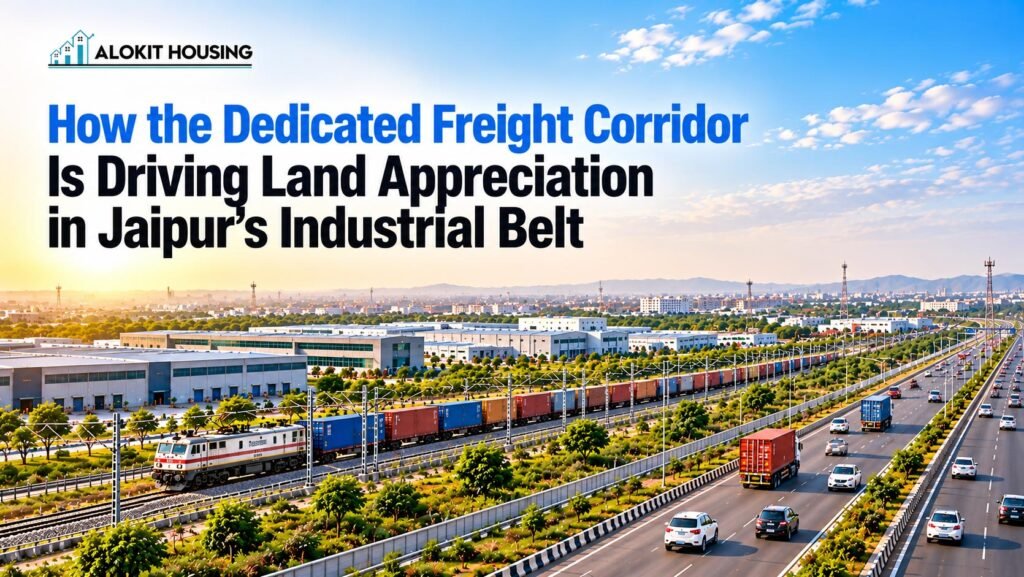
The location of this corridor close to the Dedicated Freight Corridor (DFC) enhances the industrial and logistics attractiveness of the corridor.
4. Northern Ring Road Corridor
The future expansion of the Northern Ring Road with connectivity back to NH-48 via the Bagru node ensures future structural connectivity around the periphery of Jaipur.
Individual Strategy: Transitioning to Residential Plot Investments
How can investors achieve results similar to institutional land banks? As per the report of the RBI Household Finance Committee, around 77% of household wealth in India is invested in real estate assets. Many of these factors relate to constructed property, which can appreciate more slowly than land in emerging areas. Those wishing to invest in institution-type capital appreciation have increasingly been considering residential land in emerging urban areas.
1. No Depreciation of Assets
While apartments and office spaces depreciate because of the building itself, a plot is just the land. The value of land increases with the development of infrastructure, but buildings will depreciate and require maintenance expenses.
2. Lesser Investment and Higher Percentage Appreciation
The acquisition of a residential plot at an earlier stage in a growth corridor tends to require less money up front compared to purchasing developed real estate in an established area. In terms of returns, land in infrastructure-driven areas may appreciate by larger percentages compared to developed property, although it is location-dependent.
3. Liquidity and Flexibility
JDA-sanctioned layouts in master-plan towns are more resalable than extensive land parcels that lack proper organisation. One can hold onto the land for future gains, construct a house thereon or use it as collateral for a loan, subject to the lender’s policies.
Approval and Title Checks
To establish the claim to land, detailed legal investigations are essential to avoid risks and disputes:
1. Approval/Conversion by JDA
Determine if the property lies inside the boundaries of the Jaipur Development Authority (JDA) and investigate if the agricultural land has been converted legally (for example, under Section 90A).
2. Title Investigation
Establish the history of ownership for at least 30 years and determine if the ownership title is clear and marketable.
3. Jamabandi Document
Review the land revenue documents (Jamabandi) to determine the ownership, acreage, and classification of the land.
4. Encumbrance Certificate
Investigate the presence of any mortgages, legal suits, or other claims on the land.
Holding Period and Ongoing Costs
Land banking involves patience; it normally takes 5 to 10 years or more depending on how fast the local infrastructure develops. The buyer should have some money for the expenses that will be incurred during the land banking process because there are no periodic returns:
A). Local Taxes and Fees
Land revenue tax or municipal property tax.
B). Boundary Walls and Fencing Expenses
It is important to create physical boundaries in order to prevent any encroachment into the piece of land.
Key Risks to Keep in Mind
Although there is high potential for gain from the practice of land banking in fast-growing zones, there are inherent structural risks that demand proper planning. Investors need to conduct thorough analysis before making any commitment of capital.
1. No Guaranteed Returns
The cyclical nature of real estate, along with any construction delays, can increase your holding period considerably, affecting your annual expected returns.
2. Illiquidity is one of the key characteristics of real estate
Land cannot be easily turned into cash without considerable effort or even losses in its value; therefore, it is not suitable when you need quick liquidity.
Conclusion
Land banking was the domain of institutional and private equity houses until now, but is accessible to the individual investor today. The same basics apply: look for infra corridors, ensure regulatory approvals and hold for appreciation. Such a strategy in growing cities like Jaipur may make a residential plot a good growth vehicle.
If you are looking for an asset that protects against inflation or can be a gift to your offspring, plots in the growth corridors of Jaipur may just fit the bill perfectly. As always with any investment, there will be challenges and risks involved too.
Want to more exploring your investment possibilities? Book an appointment now.
Frequently Asked Question:
1. What is land banking?
Land banking is the process of acquiring raw or partially developed land and holding onto it for some time until the price appreciates because of the growth and development of the area. This is unlike property development, where construction activities take place while holding onto the land. The profits are made through the appreciation of the land’s value.
2. Why do institutional investors favour land banking?
The attraction of land for institutional investors is that land is limited in supply and does not depreciate like buildings. Land requires less maintenance and management than built property. The value of land can also continue to increase as infrastructure like highways, metro systems, and industry develop.
3. In what ways can land banking safeguard you against inflation?
The land being a material possession, its price will be influenced by rising prices of consumer goods and rising costs of construction. Availability of land at locations that have good connectivity remains low despite rising demand, leading to its appreciation beyond the rate of inflation. Thus, land banking becomes a good tool against inflation.
4. What must be verified before one can invest in land for banking?
First comes the legal title and regulatory compliance. Check the documentation of ownership, land-use zoning, development authority approval, and the absence of any encumbrance. Equally important is proximity to development projects because location plays the most significant role in appreciation.
5. What is the main disadvantage from the finance perspective of land banking for individual investors?
Illiquidity and lack of cash flow. Unlike income-producing assets such as rental apartments or commercial real estate, land does not bring any revenue while incurring costs for its storage.